

Description
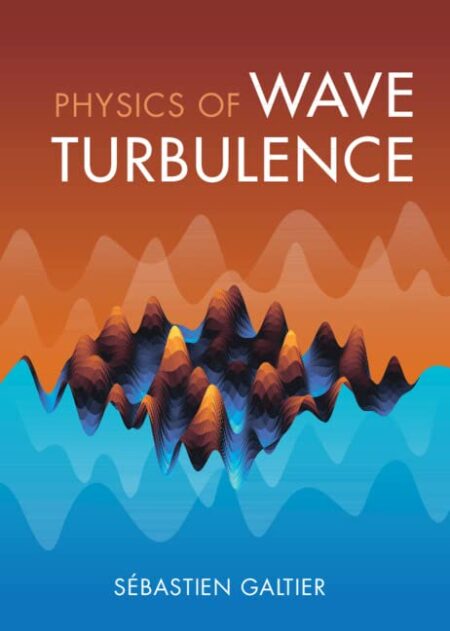
Wave Turbulence: Theory and Applications provides a modern and interdisciplinary introduction to the fascinating field of wave turbulence. Building on the pioneering work of Lewis Fry Richardson, who introduced the concept of energy cascades in turbulence more than a century ago, this textbook explores how turbulence manifests in systems dominated by weakly interacting waves.
Over the past century, advances in theoretical, numerical, experimental, and observational research have dramatically expanded our understanding of turbulence across a wide range of physical systems. While much of the traditional focus has been on eddy turbulence, commonly observed in fluids such as water, many important physical phenomena are better described by wave turbulence, where weak nonlinear interactions among waves govern the dynamics of the system.
This textbook offers a rigorous introduction to the theory of wave turbulence, beginning with the fundamental principles and historical development of the field before presenting a detailed mathematical treatment of wave turbulence in surface waves. The theory is then extended to a variety of scientific disciplines, providing readers with a broad and contemporary perspective.
Key Topics Covered
- History and development of turbulence theory
- Energy cascades and turbulence concepts
- Differences between eddy turbulence and wave turbulence
- Mathematical foundations of wave turbulence theory
- Nonlinear interactions among weak waves
- Surface wave turbulence
- Statistical approaches to turbulence
- Energy transfer and spectral dynamics
- Numerical and experimental methods in turbulence research
Applications Explored
The book demonstrates how wave turbulence theory applies to numerous areas of modern physics, including:
- Hydrodynamics and fluid mechanics
- Plasma physics
- Astrophysics
- Cosmology
- Geophysical and environmental systems
- Nonlinear wave phenomena
Key Features
- Comprehensive introduction to the theory of wave turbulence
- Rigorous mathematical treatment of weakly nonlinear wave systems
- Interdisciplinary approach connecting multiple branches of physics
- Coverage of both theoretical foundations and practical applications
- Incorporates developments from modern research and observations
- Suitable for advanced students and researchers interested in turbulence and nonlinear dynamics
Why This Book Is Valuable
Wave Turbulence: Theory and Applications helps readers:
- Understand the fundamental principles governing turbulent wave systems.
- Explore the differences between eddy and wave turbulence.
- Learn how nonlinear wave interactions shape physical phenomena.
- Connect mathematical theory with real-world applications in physics and cosmology.
- Gain a modern perspective on one of the most challenging topics in theoretical physics.
Who Should Read This Book?
This textbook is ideal for:
- Students of Fluid Dynamics
- Students of Plasma Physics
- Students of Astrophysics
- Researchers in turbulence and nonlinear dynamics
- Physicists and applied mathematicians
- Graduate students studying theoretical and computational physics
Key Benefits
- Provides an authoritative introduction to wave turbulence theory
- Bridges multiple scientific disciplines through a common theoretical framework
- Explains complex mathematical concepts in a structured and accessible manner
- Demonstrates the importance of turbulence research in modern physics
- Serves as both a graduate-level textbook and a valuable research reference
Wave Turbulence: Theory and Applications is an essential resource for anyone seeking a deep understanding of wave turbulence and its role in hydrodynamics, plasma physics, astrophysics, and cosmology.





Reviews
There are no reviews yet.