

Description
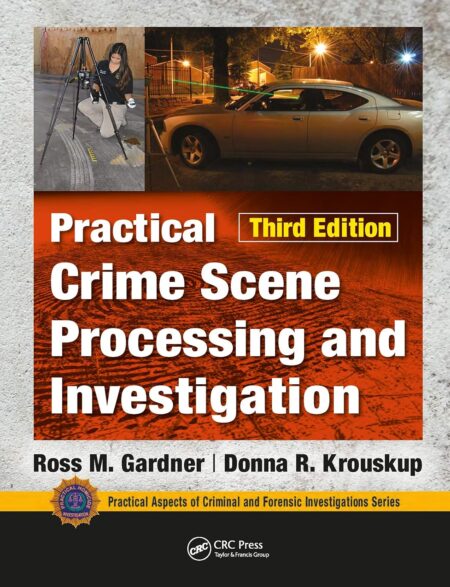
Practice Crime Scene Processing and Investigation, 3rd Edition provides a comprehensive introduction to the principles, responsibilities, and professional practices involved in crime scene investigation. Designed to help students understand both what crime scene investigators need to do and why each action matters, the textbook emphasizes the importance of recovering evidence while preserving the broader context of the scene.
A central theme of the book is objectivity and professional ethics. Crime scene investigators have a responsibility to document, collect, and preserve information based on the evidence rather than assumptions or preconceived conclusions. The text explains how careful and impartial crime scene processing supports the integrity of the justice system.
The third edition covers a broad range of forensic evidence, including fingerprints, biological evidence, trace evidence, hair and fibers, impressions, and other physical evidence. It also addresses scene assessment, search considerations, crime scene photography, sketching and mapping, documentation, crime scene analysis and reconstruction, and bloodstain pattern analysis.
Specialized topics include fire scenes, buried bodies, entomological evidence, and the body as a crime scene. The edition also introduces emerging technologies and updated techniques, including 3-D laser scanning for documenting crime scenes.
With more than 415 figures, including over 300 color photographs, the textbook provides visual support for understanding crime scene procedures and documentation. New chapters cover light technology and crime scene processing techniques, fingerprint recovery, and casting methods. Review questions at the end of each chapter help students reinforce key concepts.
Practice Crime Scene Processing and Investigation, 3rd Edition is a practical resource for students preparing for careers in crime scene investigation, forensic science, criminal justice, and related fields.





Reviews
There are no reviews yet.